CV checker: a 20-point checklist to test your CV before you send it
Check my CV: a 20-point UK checklist covering length, layout, wording, evidence and errors, so you can review your own CV in 15 minutes before applying.
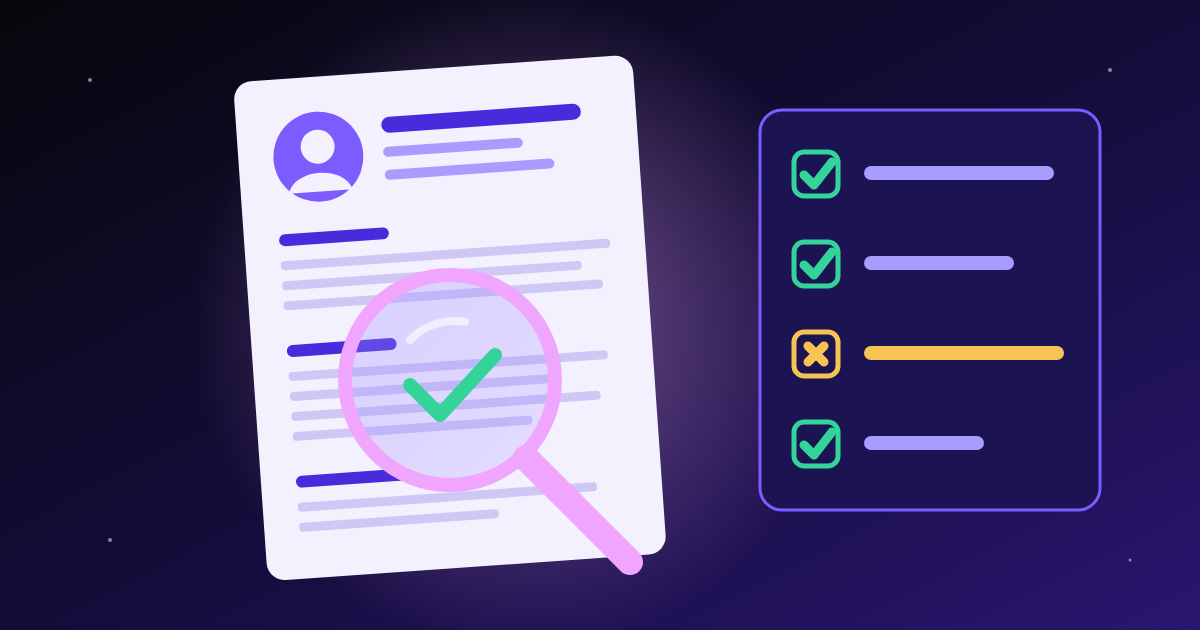
You don't need software to check your CV. You need a clear list of what to look for and about fifteen minutes with the document open. Below is a 20-point CV checker you can work through yourself, grouped into five short rounds. Most CVs that don't get a reply fail on a handful of these points, and nearly all of them are quick to fix.
Print your CV if you can, or at least change the zoom and font on screen so it looks unfamiliar. Mistakes hide in text you've read fifty times. Tick each point as you go, and mark anything you're unsure about to come back to.
The quick-check table
If you only have two minutes, scan this first. Every row is explained further down.
| Check | What good looks like |
|---|---|
| Length | One to two pages |
| File | PDF or Word, named properly, opens cleanly on a phone |
| Top of page 1 | Name, contact details and a short profile, nothing wasted |
| Job entries | Newest first, with dates, employer and job title |
| Bullets | Start with what you did, and include an outcome where you can |
| Match | The wording reflects the job advert |
| Errors | Zero spelling, grammar or date mistakes |
Round 1: layout and length
1. It's one or two pages. There is no official rule, but in the UK one page is common for school leavers and students, and two pages is normal for most other people. If you're on three, you're probably including detail from too long ago.
2. The layout is plain and consistent. One readable font, the same heading style throughout, and enough white space that the page doesn't look like a wall. Fancy columns, text boxes, icons and charts can confuse the software some employers use to read CVs, so keep it simple.
3. Your sections are in a sensible order. For most people: contact details, a short profile, work experience, education, then skills or extras. If you're a recent graduate, education can come before work experience.
4. The file type and name are right. Unless the advert says otherwise, send a PDF or a Word document. Call it something like Your-Name-CV.pdf, not CV-final-v7-NEW.docx. Open the file on your phone too, in case it's read there.
5. Everything important is on the first half of page 1. A recruiter may give your CV only a quick scan. Your name, how to reach you, and your strongest reason to be shortlisted should be visible without scrolling.
Round 2: the top of the page
6. Your contact details are current. Name, phone number, email address and your town or city are enough. A professional email address helps: a version of your name, not a nickname from school.
7. There's no unnecessary personal information. UK employers don't need your date of birth, marital status, photo or full home address. Under the Equality Act 2010 they shouldn't make decisions on protected characteristics like age or religion, and leaving these details out keeps the focus on your skills.
8. The profile is short and specific. Three or four lines at most: who you are, what you're good at, and what you're looking for. "Hard-working team player seeking a challenging role" could be about anyone. "Warehouse operative with two years' experience in fast-paced picking and packing, looking for a full-time role in logistics" tells the reader something real.
Round 3: the experience section
9. Jobs are in reverse order, with dates. Newest first. Each entry should show the employer, your job title and the months or years you worked there. Check for overlaps and unexplained gaps. A short note such as "career break to care for a family member" is better than silence.
10. Each bullet begins with an action. "Served an average of 60 customers per shift" is stronger than "Responsible for customer service". Use verbs such as organised, trained, resolved, prepared, reduced and managed.
11. You've shown results where you honestly can. Numbers help, but only if they're true: how many people you supported, how often you did something, how much time or money you saved. If you don't have a figure, describe the outcome instead: "so the team could close the shop on time".
12. Duties aren't just listed. A page of "answered phones, filed documents, attended meetings" says what the job was, not what you did well. For each role, ask yourself what you improved, fixed or were trusted with.
13. Old or irrelevant jobs are shortened. Roles from many years ago can shrink to one line each. Give most of your space to the recent and relevant ones.
Round 4: fit for this job
14. It matches the advert. Open the job advert beside your CV. Highlight the skills and requirements it mentions most. Are they on your CV, in the advert's own words, where they're true? Employers often search or scan for those exact terms, and a human reader looks for them too. If you apply for different kinds of job, you need different versions of your CV.
15. The skills section is honest and backed up. List the skills the role needs, and make sure your experience bullets prove at least the main ones. A skills list with nothing underneath it is only a claim.
16. Your education and qualifications are correct. Give the qualification, subject, institution and year. For GCSEs, you can summarise ("8 GCSEs, grades 9 to 4, including English and Maths") instead of listing every one. If a job requires a licence, registration or certificate, such as an SIA licence, a CSCS card or NMC registration, make sure it's clearly shown. (New to site work? Here's how the CSCS card works and how to get a construction job.)
Round 5: the final proofread
17. There are no spelling or grammar mistakes. Run the spell-checker, then read it again yourself, because a spell-checker won't catch "manger" for "manager". Use British spelling (organised, programme, licence for the noun). Read your CV out loud, or read it from the bottom up, line by line.
18. Every date, name and number is right. Check job titles, months and years. Make sure the company name is spelled as the company spells it. If you've reused the CV, search for the name of the last employer you applied to, in case it's still in there.
19. Someone else has read it. A friend, family member or colleague can spot unclear wording in seconds. Ask them one question: "After thirty seconds, what do you think I'm best at?" If their answer isn't what you wanted, your top section needs work.
20. Nothing is exaggerated. Anything on your CV can come up in an interview, and employers can check qualifications and references, so every claim should be one you can explain.
A worked example: fixing one weak bullet
Take this line from an admin assistant's CV:
Before: Responsible for answering emails and phone calls.
It describes a duty, with no sign of how well it was done. Here's a rewrite, using only details the person can truthfully confirm:
After: Handled around 40 emails and calls a day for a six-person team, passing urgent queries to the right person the same day and keeping the shared inbox clear by 5pm.
The second version has the same job in it, plus scale, speed and a result. Apply that edit to the top three bullets of each recent role and the whole CV reads differently.
What a CV checker can't do
Online CV checkers and review tools can spot typos or odd formatting, but treat their scores with caution. They can't know the advert you're answering or what you've truly done. Never add a skill or achievement just because a tool suggests it.
If you're hunting in a big market, your CV is only one part of the picture; our guide to finding a job in London covers where to look and how to stand out. Moving into tech without a tech job behind you? See how to get an IT job in the UK for turning everyday experience into IT evidence, or our guide to data analyst jobs in the UK if your strength is spreadsheets and reporting.
Next step: be ready to talk about it
A strong CV gets you invited. The interview then tests whether you can talk about it. Every bullet you've written is a possible question, so choose the three or four you're proudest of and practise explaining them. Our guide to answering "Tell me about yourself" shows how to turn your CV into a spoken story.
Saying your answers out loud is a different skill from writing them. With Interview Pal you can practise exactly that: it asks tailored questions about your role, listens to your spoken answers, gives each a score out of 10 with spoken feedback, and shows a recommended answer. It works on your phone too, so a spare ten minutes counts.
Work through the 20 points once, fix what you find, and your CV will be in much better shape than most that land on a recruiter's desk. Use this CV checker again each time you tailor the document to a new job, and if you'd like a routine for the rest of the process, our guide to applying for jobs sets out a week that works.
Frequently asked questions
How long should a UK CV be?
Usually one to two pages. School leavers and students often fit everything on one page, while experienced people use two. Cut detail that isn't relevant to the job rather than shrinking the font.
Should I put a photo on my CV in the UK?
Generally no. UK employers don't expect one, and leaving it out helps keep the focus on your skills and experience. Some acting and modelling roles are an exception.
How often should I update my CV?
Check it before every application, and update it whenever you finish a project, learn a new skill or change job. Tailoring it to each advert matters more than polishing one general version.
Do I need a different CV for every job?
You don't need to rewrite it from scratch, but you should adjust the profile, the order of your bullets and the keywords so the most relevant evidence is easy to find for that particular role.